
Kanemitsu on Traction
OPENING RECEPTION: February 28, 4:00-7:00 PM. Dates and times subject to change. Please sign our guest list to receive the latest updates about this exhibition.
Matsumi (Mike) Kanemitsu (1922–1992) was an American artist of Japanese descent whose life and work unfolded across borders, cultures, and some of the defining events of the twentieth century. Born in Ogden, Utah, Kanemitsu spent his formative years in Japan before returning to the United States, renouncing his Japanese citizenship, and enlisting in the Army. Following the attack on Pearl Harbor, he had the unusual experience of being both an American soldier and prisoner of war. He was incarcerated in various army bases before returning to military duties across the United States and Europe. These experiences would profoundly shape both his life and his artistic vision.
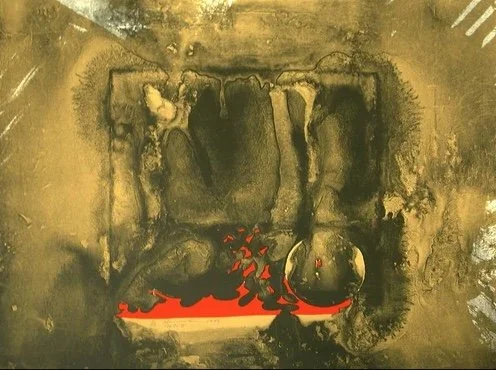
Matsumi Kanemitsu – Homage to Henry Seldis II, lithograph, 21.75” x 29”
After the war, Kanemitsu emerged as a significant figure in Abstract Expressionism, building a career that took him first to Baltimore and then to New York, where Jackson Pollock famously gave him the nickname “Mike.” He began visiting Los Angeles in the 1960s for yearly exhibits at the Virginia Dwan Gallery and residencies at the Tamarind Lithography Workshop. (See “Four Stones For Kanemitsu” an Oscar-nominated short filmed at Tamarind.) By the 1970s, he relocated to Los Angeles to teach at the Chouinard Art Institute, then CalArts and, finally, Otis Art Institute. He eventually settled in a studio on Traction Avenue, in a building directly across from Al’s Bar.
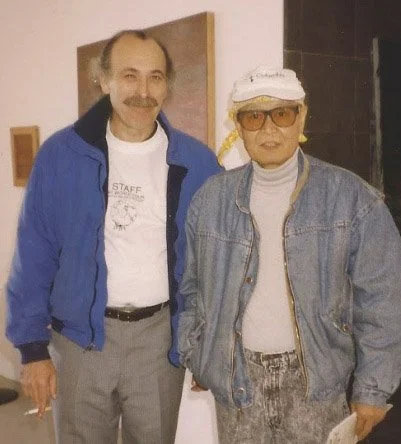
Marc and Mike at the American Gallery, circa 1982
A single father, Kanemitsu was not a regular presence inside Al’s Bar, nor was he a frequent fixture on the social scene. More often, he’d be found working in his studio. Even so, he formed a friendship with his neighbor Marc Kreisel and was regarded with quiet respect as part of the extended Al’s Bar community—an artist whose proximity, stature, and seriousness placed him just adjacent to the energy of the scene without ever seeking its center. His work was included in the Functionists High exhibition at Kreisel’s American Gallery, curated by Katy Crowe and others. During these years, he was internationally recognized as a major figure in postwar American art, even as his daily life remained largely private and focused on work.
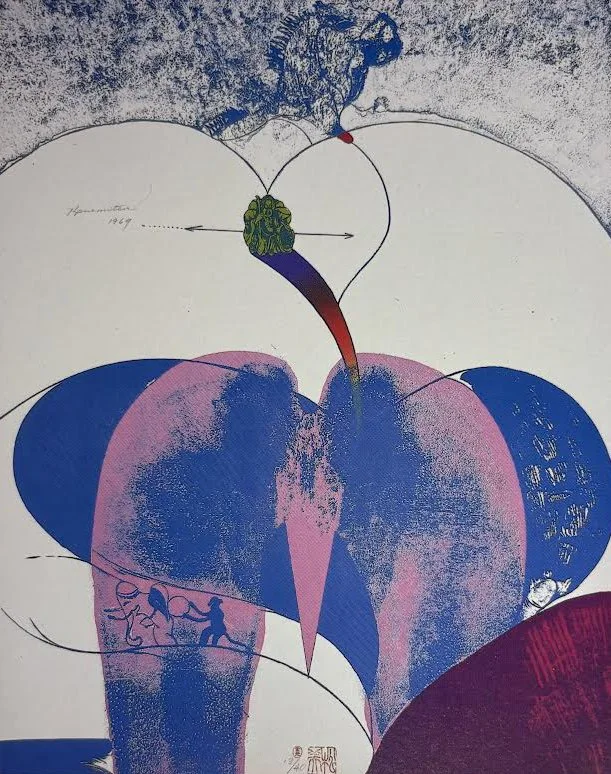
Matsumi Kantemitsu – Oxnard Madam, lithograph
Kanemitsu on Traction focuses on the lithographs and woodcuts Kanemitsu produced between 1970 and 1990—the body of work he developed while living and working near Al’s Bar. While he would always identify as a painter rooted in the New York School, Los Angeles and lithography were crucial to his artistic development and his cultural legacy. Through his printmaking practice, Kanemitsu brought together elements of his utterly idiosyncratic trajectory. Seen together, these works reveal an artist in full command of his language, balancing rigor and intuition, discipline and freedom, shaped as much by inward focus as by outward circumstance.
Commentary about Mike:
“When he’s in his work it’s as if nature itself is painting.” – Jackson Pollock
“Nobody is as lightning-inventive on a piece of paper.” – Peter Plagens